
Petrol Crisis Preparedness: What Victorians Really Think About Fuel Security
New research reveals strong public support for local fuel production and rationing measures — but willingness to change behaviour varies widely.
As global instability continues to disrupt fuel supply chains, Australians are confronting uncomfortable questions about energy security. Recent research conducted by Redge among 634 Victorian residents reveals how everyday people are responding to rising petrol prices — and what they expect from government if supplies are severely disrupted.
The Price Point: When Would You Switch?
Our research asked Victorians at what petrol price they would seriously consider using public transport instead of driving. The results show a clear price threshold emerging:
- 24% would switch at around $3.00 per litre
- 19% would switch at around $2.50 per litre
- 12% would switch at around $3.50 per litre•
- 21% say they would not consider switching regardless of price
- 10% already mostly use public transport
This suggests that for many Victorians, $3.00 per litre is the tipping point where driving becomes economically unsustainable — a threshold we're not far from in current market conditions.
Behavioural Change: What People Will Actually Do
When asked what changes they'd consider if petrol prices remain high, Victorians showed a pragmatic mix of responses (n=634):
Top responses:
- 48% — Reducing non-essential travel
- 47% — Taking public transport instead of driving
- 26% — Working from home more
- 16% — Carpooling
- 15% — Switching to a more fuel-efficient vehicle
The data shows that behaviour change is concentrated in trip reduction and mode shift, rather than vehicle replacement — perhaps reflecting the immediate financial pressure petrol prices create, compared to the capital cost of buying a new car.
Rationing: Surprising Support for Emergency Measures
Perhaps the most striking finding is public willingness to accept fuel rationing in a crisis scenario. When asked if they would support petrol rationing if fuel supplies were severely disrupted:
- 38% somewhat support
- 24% strongly support
- 23% neither support nor oppose
- Only 14% oppose (8% somewhat, 6% strongly)
62% of Victorians support or somewhat support fuel rationing in an emergency — a remarkable level of acceptance for what would be highly disruptive government intervention.
Who Should Get Priority Access?
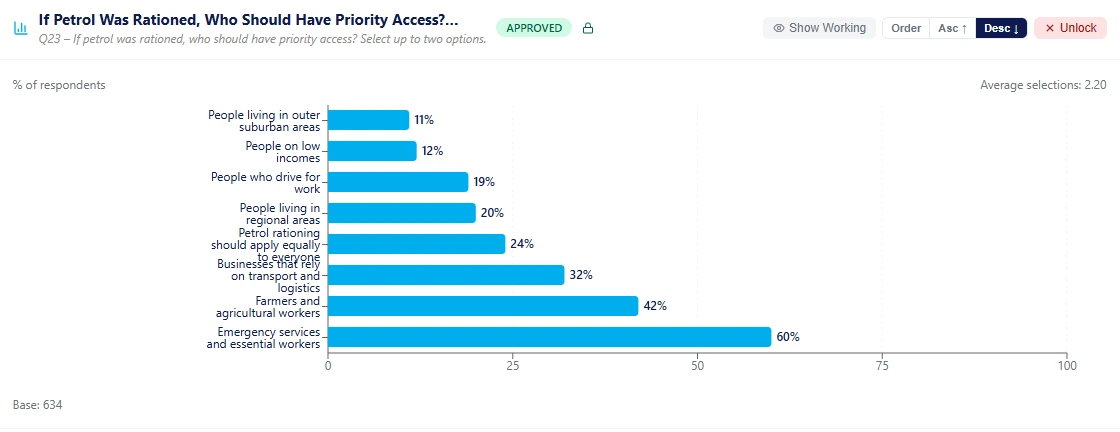
When asked who should have priority access to fuel if rationing were implemented (respondents could select up to two options), Victorians showed clear priorities (n=634): Emergency services and farmers are seen as critical — with 60% prioritising emergency workers and 42% supporting farmers. Notably, 24% believe rationing should apply equally to everyone, suggesting a strong egalitarian streak even in crisis planning.
Local Production: Overwhelming Support
The research reveals near-unanimous support for domestic fuel production:
- 88% say Australia should start making more of its own fuel locally
- Only 5% oppose
- 7% are unsure
However, when asked if they'd personally pay more for locally-made fuel:
- 44% yes
- 29% no
- 27% unsure
This gap between principle and price sensitivity is important: while Australians overwhelmingly support local fuel production in theory, less than half are willing to pay a premium for it. This suggests policy solutions will need to balance energy security with affordability.
Who's to Blame?
Public opinion on responsibility for high petrol prices is revealing (n=634): 44% blame international conflicts — likely reflecting the Iran war and Middle East tensions — while 21% point to the Federal Government. Interestingly, oil companies receive relatively little blame (9%), suggesting Victorians see this as primarily a geopolitical and policy issue rather than corporate profiteering. That said, concern about oil company profits is extremely high:
- 57% are very concerned companies will use the crisis to increase profits
- 37% are somewhat concerned
- Only 7% are not concerned
The Electric Vehicle Question
The current petrol situation is shifting attitudes toward electric vehicles:
- 50% say they're now more likely to consider an EV (19% much more likely, 31% somewhat more likely)
- 35% say no difference
- 10% are now less likely
- 5% already own an EV
Half of Victorians say fuel prices are making them more likely to go electric — a significant potential acceleration in EV adoption if sustained.
What This Means for Transport Planning
The research reveals several critical insights for policy makers and transport planners:
1. Public transport alternatives are essential
Nearly half of respondents (47%) would switch to public transport if petrol prices stay high — but only if viable alternatives exist. When asked what single transport priority government should fund first:
- 29% said more frequent and reliable bus services
- 19% said train or tram upgrades
- 16% said safer stations and stops
Improving public transport frequency and reliability is the clear priority — particularly critical if fuel prices force mode shift.
2. Regional vulnerability is higher
People living in regional areas face acute vulnerability in a fuel crisis. They're more car-dependent, have fewer public transport alternatives, and 20% of respondents nominated regional residents for priority fuel access in a rationing scenario.
3. Work-from-home is the pressure valve
26% would work from home more if petrol prices stay high. This represents a significant potential reduction in peak-hour travel demand — but only for knowledge workers with that flexibility.
4. Behavioural change has limits
While many Victorians are willing to adapt, 21% say they would not switch to public transport regardless of price. This likely reflects people with no viable alternatives — parents with school drop-offs, shift workers, tradespeople, or those in poorly-serviced areas.
The Bigger Picture: Energy Security and Transport Policy
This research arrives at a critical moment. Global fuel supply chains remain vulnerable to geopolitical shocks, yet Australia imports 90% of our refined fuel products. We have limited strategic reserves and decreasing domestic refining capacity.The findings suggest Victorians understand these vulnerabilities and are willing to accept significant government intervention in a crisis — including rationing. They overwhelmingly support building local fuel production capacity, even if they're divided on paying a premium for it. But perhaps most importantly, this research shows that transport resilience and fuel security are inseparable. The quality of our public transport directly affects our vulnerability to fuel shocks. Investment in frequent, reliable, accessible public transport isn't just about congestion or emissions — it's about national resilience.
About This Research
This research was conducted by Redge for The Agenda Group's Community Pulse between March 26 and April 1, 2026 among 634 Victorian residents (82% Metropolitan Melbourne, 18% Regional Victoria; Margin of error ±3.9% at 95% confidence). The survey explored transport behaviour, fuel prices, public transport satisfaction, and attitudes toward fuel rationing and energy security.
Redge specialises in fast-turn around research— helping organisations understand public sentiment on complex policy questions.
Want to explore this data further? Contact us to discuss custom analysis or commission your own research on transport, energy, or community issues.