
Ask any researcher to list depth-interview techniques and "laddering" will be near the top. Ask them to sit through one done badly, and they'll wince. There's a reason for that gap, and it's worth understanding — because laddering is one of the most powerful tools in qualitative research, and one of the most routinely mangled.
What laddering actually is
Laddering is a structured way of climbing from a product attribute up to the personal value underneath it. You start with something concrete and functional, and you follow the chain of meaning until you reach the part of a person's identity that the choice is really connected to.
In the chocolate category, a ladder might run like this: "it's lower in sugar" → "so I don't feel sluggish afterwards" → "so I feel in control of myself" → "because being in control is how I prove to myself I've got my life together." The attribute is sugar. The value is self-worth. Laddering is the discipline of tracing the rungs between the two.
Done well, it surfaces the why behind a preference — the emotional and identity-level drivers that people can't hand you directly because they've never had to articulate them. That's gold for brand positioning, territory exploration, and category understanding. It's the difference between knowing what someone buys and knowing who they're being when they buy it.
What it isn't
Here's where it goes wrong. Laddering is not asking "why" five times in a row.
I still wince about a project from years ago. I was the local moderator on a global study, running 90-minute depth interviews with chocolate consumers, with one rule from the central team: do not stray from the guide, ever. So I asked the same chained questions in the same order regardless of what anyone said. It was miserable for the respondents who had to endure it, and for me, who had to inflict it on them. That wasn't laddering. It was an interrogation, and an interrogation is the fastest way to make a respondent shut down.
Real laddering reflects back what the person actually said. It follows the specific thread they've opened rather than the next line on a script. It asks one good probe instead of five lazy ones. And it knows when to stop. The craft isn't in the climbing — it's in reading the answer and choosing the right next move.
When to use it — and when not to
I reach for laddering when I need the values driving a choice, not just the choice itself: brand and category exploration, positioning work, understanding the meaning a product carries in someone's life.
I leave it on the shelf when there's genuinely no ladder to climb. Plenty of low-involvement decisions are exactly what they look like — people buy the cheap one because it's cheap, and pushing for a deeper "why" invents a meaning that was never there. I skip it, too, for quick reaction checks where depth isn't the point, and I tread carefully on sensitive territory, where pressing for "why" starts to feel like pressure.
The part that separates good moderating from harm: guardrails
A ladder in the chocolate category climbs into "I've earned it" and "I really shouldn't have" remarkably fast — and from there it's a short step to weight, health, and body image. A skilled moderator senses that edge and steps back from it. They acknowledge what was said, warmly, and move on rather than digging into something that could distress the respondent or stray into territory the client never wanted to touch.
That restraint is part of the technique, not an add-on to it. A good laddering instruction reads as much about where not to go as where to. For an ethically-minded client, I'll make it as explicit as: probe gently for the permission or guilt behind the indulgence, but the moment anyone mentions a health condition or body image, acknowledge it kindly and do not probe further. Knowing when to stop is the craft.
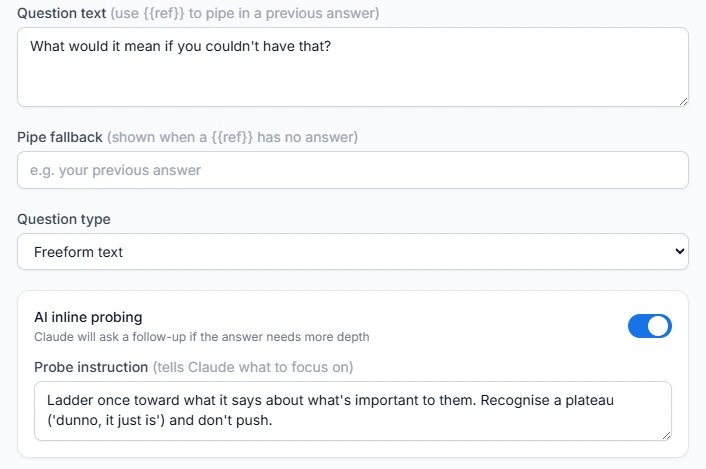
Where AI moderation comes in
For most of laddering's history, the constraint was simple: a good moderator can only be in one room at a time. Depth interviews are slow and expensive, so they run at small samples, and a lot of qualitative research that should happen never gets commissioned.
AI in market research changes the maths. An AI moderator can run genuine laddering — reading the actual answer, following the real thread, probing once and stopping — across a meaningful sample, in parallel, at a cost closer to a survey than a focus group. But only if it's built to do the technique properly, guardrails and all. A moderator that just reads the same five questions off a guide, human or machine, isn't laddering. It's the thing that made everyone wince in the first place.
The technique still matters. We've just got a better way to use it.
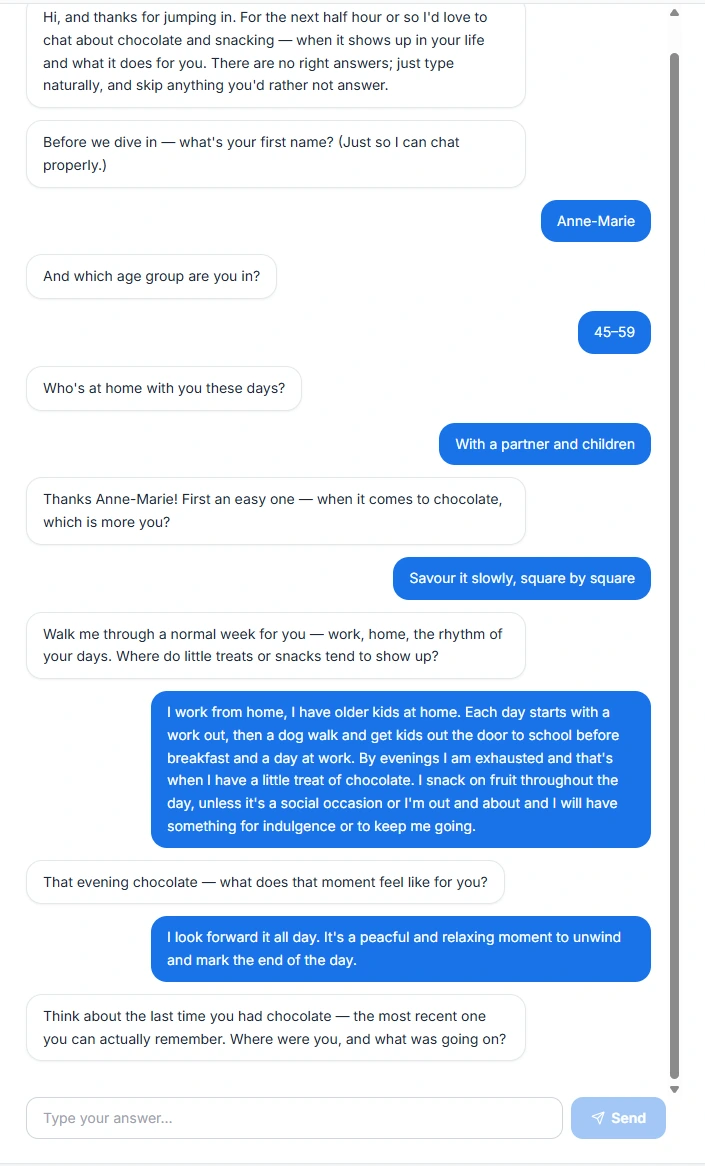
Redge 2.0 is an Australian-hosted, AI-moderated interview platform that runs depth techniques like laddering at the scale of an online survey — with a senior researcher keeping the judgement. Book a demo and see an AI-moderated interview run end to end.